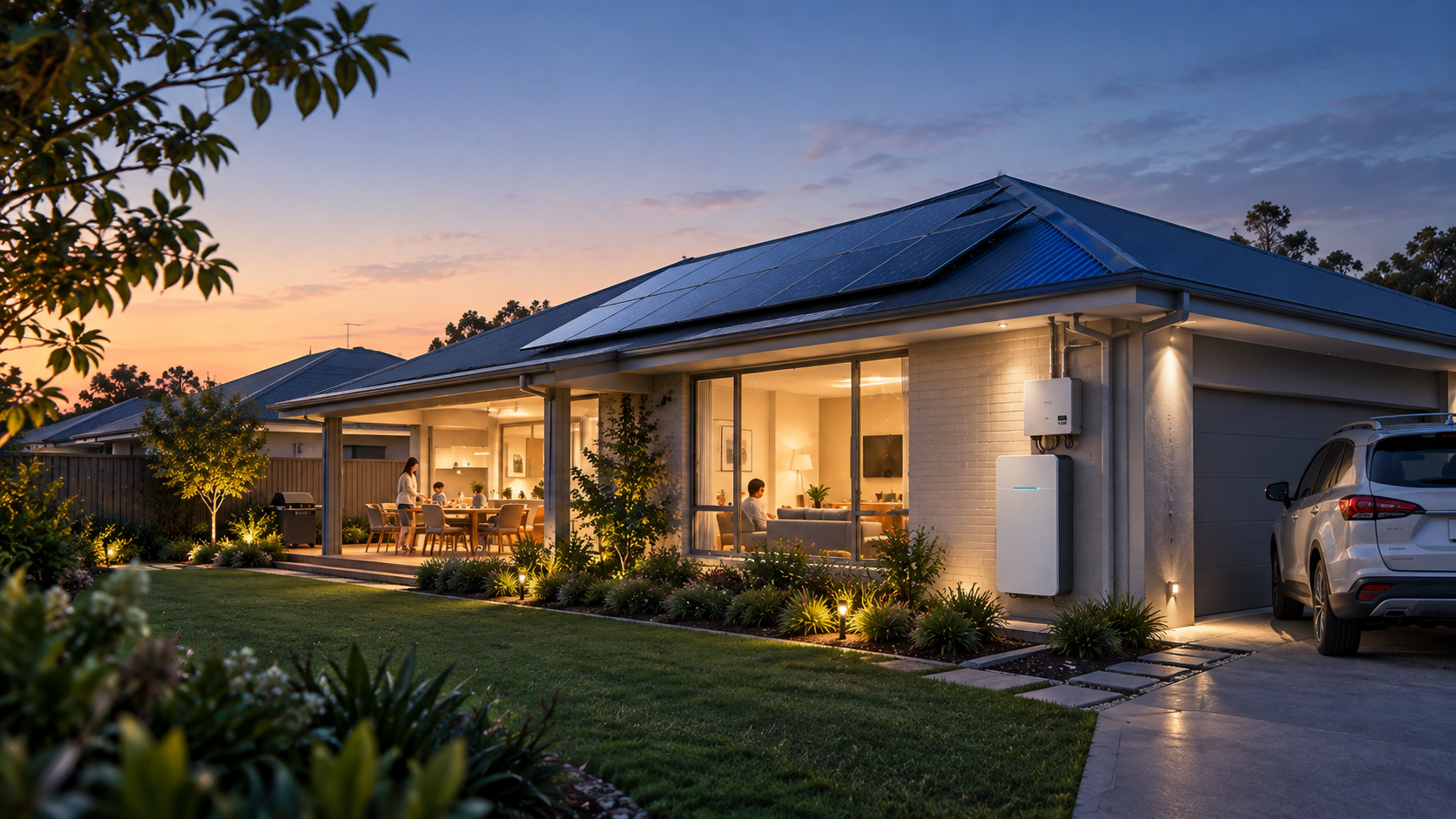

Battery Storage
Battery payback, honestly calculated
How to work out whether storage pays for itself on your usage pattern — and when it does not.
Coming soon
FAQ & guides
Browse practical guides, then find straight answers on commercial solar, battery storage, maintenance, finance and procurement.
Guides
Short reads, updated as the rules change.
Financing & Procurement
Export rates have fallen from 12c to under 5c in most states. Here is what changed and what to do about it.
Read the guide
Battery Storage
How to work out whether storage pays for itself on your usage pattern — and when it does not.
Coming soon
Financing & Procurement
Federal STCs plus the current state battery incentives, and how they stack.
Coming soon
Commercial Solar
Why the default package is rarely the right size, and how export limits change the maths.
Coming soon
Commercial Solar
The three inverter types explained, with the roof and shading conditions that suit each one.
Coming soon
Financing & Procurement
Daily supply charges, peak windows and controlled load — the lines that decide your savings.
Coming soon
FAQ
Planning, sizing and operating a commercial solar system.
Installing a commercial solar system can help your business manage rising electricity costs by generating renewable energy on-site and reducing your reliance on grid power. It can be a cost-effective way to lower energy expenses without significantly changing your day-to-day operations. Solar can also support your sustainability goals, helping demonstrate your business's commitment to renewable energy and a more environmentally conscious future.
On average, our clients achieve savings of around 30% on their energy bills during the first 12 months following installation. The amount your business can save will vary depending on several factors, including:
There isn't a single solar solution that works for every business. The right system depends on your premises, energy needs, available space and how that space can be used effectively. A tailored approach can help you make the most of your property and select a system that suits your specific circumstances, with a range of solar options available to meet different business requirements.
The ideal solar system size depends on your business's energy usage and when that energy is consumed. To maximise the value of your solar investment, the goal is generally to use as much of the electricity generated by your system as possible, rather than sending excess energy back to the grid. One common approach to estimating the required system size is to calculate your business's average minimum daily energy load over a seven-day period.
Commercial solar systems are available across a range of capacities, with the most suitable size depending on the energy requirements and characteristics of your business.
The upfront cost of a commercial solar system can vary significantly depending on the type of installation and the requirements of your site. Factors such as whether you choose a rooftop, ground-mounted or solar car shade system can affect the overall investment. The complexity of integrating the system with your existing commercial property, as well as the way you choose to procure the system, will also influence the final cost.
Solar panels typically have an expected lifespan of around 25 to 30 years. Many reputable manufacturers also provide product performance warranties covering 25 years or more. Regular professional maintenance can help keep your system operating efficiently and maximise the useful life of your panels.
Yes, an existing solar system can generally be expanded when your business's energy consumption grows. Depending on your current setup, an upgrade could involve installing additional panels, replacing existing equipment with more efficient technology, or incorporating battery storage. Any modifications will need to comply with the applicable requirements of your state and electricity network provider. New components should also be compatible with your existing solar panels, inverters and battery storage to ensure the expanded system operates effectively.
Yes. Businesses can install solar even when operating from leased premises. Many commercial solar projects are carried out for tenants, so owning the property is not necessarily a requirement.
For landlords, having a commercial solar system installed on a property can also provide several potential benefits, including:
Yes. QSX provides a contractual performance guarantee for its commercial solar systems. Each system is guaranteed to achieve at least 90% of its forecast energy generation, with ongoing system monitoring, operations and maintenance included to help support its performance.
FAQ
Capacity, backup and day-to-day battery operation.
A commercial battery energy storage system (BESS) captures electricity generated by solar panels or supplied from the grid and stores it for later use. When energy is needed, the stored power can be released back into the electrical system. This gives businesses greater control over when and how they use electricity and can help them manage their energy consumption more effectively.
The expected life of a commercial battery varies depending on factors such as its chemistry, how frequently it is charged and discharged, and how well it is maintained. Lithium-ion batteries generally have a lifespan of around 10–15 years and can achieve up to approximately 10,000 charge and discharge cycles over their operating life. Lead-acid batteries typically have a shorter cycle life, with around 500–1,200 cycles.
The most suitable battery configuration will depend on your energy consumption, existing infrastructure and operational requirements. Common options include:
Commercial battery systems are relatively compact, with many units having a footprint similar to that of a tall refrigerator. As a general example, a 100kWh battery system may require approximately 2m of height, 1m of width and 1m of depth.
Lithium-ion technology is also relatively space-efficient and can typically operate across a temperature range of around 0°C to 38°C, making it suitable for outdoor applications. Its higher energy density means lithium-ion batteries can provide the same or greater storage capacity while taking up less space than comparable lead-acid systems.
Battery storage systems need to be properly designed, installed and monitored to manage potential risks. Key considerations include:
For businesses that already have solar, battery storage can be a way to make greater use of the energy they generate and reduce their dependence on grid electricity. With changing energy prices creating greater uncertainty around future operating costs, batteries can provide businesses with additional control over when they use and store energy.
If your business has experienced significant increases in electricity costs and already has a solar system, a battery feasibility assessment can help determine whether storage is financially suitable based on current energy rates and your site's consumption patterns.
As businesses look to increase their use of renewable energy, simply generating more solar during the day may not always be sufficient. Excess solar generation can be exported to the grid rather than used on-site. A suitably sized battery can capture some of this surplus energy and make it available when the business needs it, potentially improving the financial value of the overall renewable energy system.
Battery storage can be used for more than simply supplying electricity to a business after the sun goes down. Depending on the system and market conditions, common applications include:
FAQ
Keeping panels, inverters and batteries performing as designed.
Regular maintenance is important to keep your solar system operating safely and efficiently. Like other electrical equipment, solar panels are exposed to UV rays and changing weather conditions, which can contribute to wear and deterioration over time. Without proper care, this may gradually reduce system efficiency and energy generation, while potentially shortening the overall lifespan of the panels.
How frequently your solar panels need cleaning will depend on factors such as your location, climate and system size. In many cases, regular cleaning may not be necessary, as rainfall naturally removes much of the surface dirt and debris. For this reason, cleaning is often best treated as a reactive maintenance service rather than a fixed routine. However, sites such as manufacturing facilities and agribusinesses may experience greater levels of dust and other particulates that can accumulate on the panels and are less likely to be removed by rain. These sites may benefit from an annual clean to prevent stubborn build-up. Soiling levels can also be monitored remotely, particularly during the first year of operation. If your site shows recurring build-up that affects the system, scheduled cleaning may be a worthwhile addition to your maintenance program.
While some basic maintenance tasks can be done yourself, hiring a professional service provider may be necessary when dealing with the more challenging tasks that require specialized knowledge and equipment.
FAQ
Comparing proposals, approvals and ways to fund a project.
CapEx, or capital expenditure, is when a business purchases a solar system outright using its available cash or free cash flow. This approach can provide strong returns, with typical payback periods of around 4–6 years. However, the business remains responsible for ongoing operation and maintenance, as well as the cost of replacing components that fail outside their applicable warranty periods.
A CapEx purchase may be suitable for a business that:
Solar financing allows a business to install a system without using a large amount of its available capital upfront. Instead, the business can retain its funds for other priorities and finance the solar investment through options such as a loan or lease.
Financing may be appropriate for businesses that:
The key distinction between a solar lease and loan is who owns the system and how the arrangement is treated from a tax perspective.
A Power Purchase Agreement (PPA) is a long-term arrangement that allows a business to use solar energy without purchasing the solar system itself or making an upfront capital investment. Under a PPA, the provider installs, owns and operates the solar system and is responsible for its ongoing maintenance. The business then purchases the electricity generated by the system, typically at a rate below the cost of electricity supplied from the grid.
A PPA can provide businesses with access to renewable energy without having to take on the upfront cost, ownership responsibilities or ongoing maintenance of a solar system.
A PPA may be suitable for businesses that:
Changes in electricity prices and seasonal fluctuations can make energy costs difficult for businesses to predict. Solar can help reduce this uncertainty by generating electricity on-site and lowering reliance on grid-supplied power.
Because solar costs are relatively predictable once the system is installed, the energy savings generated can help offset the system's purchase or finance costs. In some cases, the full system can achieve payback in less than five years.
For example, a 100kW solar system can potentially reduce electricity costs by up to $25,000 per year compared with purchasing the same electricity from the grid. Across systems of different sizes, the resulting energy savings may support payback periods of under five years or allow financed systems to become cash-flow positive from the first year.
Reducing exposure to electricity price increases and seasonal variations can also give businesses greater certainty when planning their ongoing operating costs.
The payback period for a commercial solar system varies according to factors such as system size, site conditions, installation costs and electricity prices.
As an example, a 100kW system may generate savings of up to $25,000 per year compared with grid-supplied electricity, while installation costs may be approximately $70,000–$90,000 depending on the specific site.
Across both smaller and larger commercial systems, the energy savings generated can support payback periods of less than five years. Depending on the finance structure, some businesses may also achieve a cash-flow-positive position from the first year.
Australian businesses may be eligible for several government-backed incentives when installing solar, depending on the system size, location and applicable program requirements.
Adding battery energy storage can improve the way a business uses its generated solar power and reduce its reliance on electricity from the grid. Commercial battery systems can help businesses manage peak demand charges and reduce exposure to fluctuations in electricity prices, potentially resulting in lower overall energy costs.
As battery technology becomes more affordable while grid electricity costs continue to rise, battery storage can become an increasingly relevant component of a commercial energy strategy. Based on recent energy rates, QSX is seeing indicative breakeven periods of around eight years for Battery Energy Storage System (BESS) installations in the 100kWh–500kWh range.
Actual returns and payback periods will depend on factors such as energy consumption patterns, electricity tariffs, system size and site-specific conditions.
Ready when you are
Our Smart Estimate tool designs a system on your actual roof and shows the numbers before you talk to anyone.